
Materials · desert performance
Patio cover materials in Las Vegas heat
Every company in this market will tell you aluminum resists heat. Almost none will tell you what the measurements say — including the one measurement that undercuts the industry's favourite upsell.
Updated 2 August 2026 · Sources verified 2026-08-02 · Independent research, not a contractor
For the Las Vegas valley, powder-coated aluminum is the durable default: $18–$30 per square foot installed for open lattice, $22–$38 for solid, $32–$55 for insulated panels, as of August 2026. Peer-reviewed field measurements from the desert Southwest show shade structures cut mean radiant temperature — the heat you actually feel — by around 31°F, while barely changing air temperature at all.
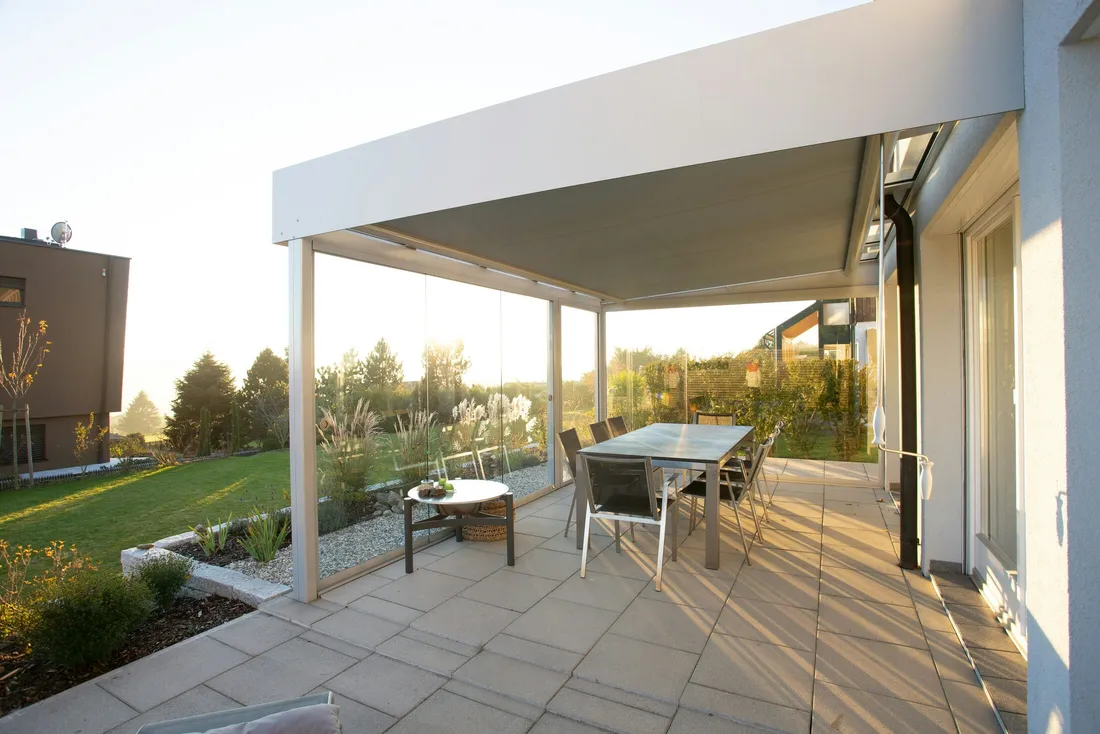
What the material is actually up against
Before comparing anything, it is worth being precise about the exposure. These are National Weather Service figures for Harry Reid International Airport, plus two code-adopted values:
| Measure | Value | Basis |
|---|---|---|
| Normal July high | 104.5°F | 1991–2020 normals, Harry Reid International |
| All-time record high | 120°F | 7 July 2024; period of record begins 1937 |
| Days per year at or above 100°F | 78.2 | 1991–2020 normals |
| Days per year at or above 110°F | 9.4 | 1991–2020 normals |
| Annual precipitation | 4.18 inches | 1991–2020 normals |
| Possible sunshine received | 85% annually | 88–93% June through August |
| Summer UV index | around 10 | EPA scale tops out at 11+, rated Extreme |
| Termite infestation probability | Moderate to Heavy | Clark County adopted code value, Table R301.2 |
Two of those deserve emphasis. Las Vegas receives 85 percent of possible sunshine annually and rises to 88–93 percent through the summer, which means a patio cover roof here accumulates ultraviolet exposure faster than almost anywhere in the country. And Clark County's own adopted building code rates termite infestation probability as "Moderate to Heavy" — a code value, not a pest-control company's sales line, and directly relevant to whether you build in wood.
What shade actually does — the measurement nobody cites
Here is where this market's marketing goes wrong in a way that is easy to check. Companies routinely claim a patio cover will make your yard "up to 20 degrees cooler". Air temperature is not what changes.
A 2021 study published in the Bulletin of the American Meteorological Society ran nine field campaigns across 2016–2019 in Tempe, Arizona — a Sonoran Desert city with a climate close enough to ours to be genuinely informative — measuring what different kinds of shade do. The findings:
| Shade type | Reduction |
|---|---|
| Lightweight engineered structures (umbrellas, shade sails) | −17.3°C (−31°F) |
| Urban form (tunnels, breezeways, deep overhangs) | −22.8 to −30.9°C (−41 to −56°F) |
| Non-native evergreen trees | −25.9°C |
| Trees, average | −13.5°C |
| Air temperature, shaded vs unshaded | under 1.3°C |
A patio cover does not cool the air in your yard — the measured difference is under about 2°F. What it does is cut mean radiant temperature, the heat load your body actually absorbs, by roughly 31°F for a lightweight structure and more for a deeper, more enclosed one. That is a bigger and more useful effect than the claim being made, and it happens to be true.
The same study found something worth knowing if you are considering an enclosed structure: after sunset, tunnels and breezeways ran 3.2°C warmer than open areas, because enclosure retains heat at night. If your patio is primarily an evening space, more enclosure is not automatically better.
Side by side
| Material | Installed $/sq ft | Heat behaviour | Maintenance | Ageing |
|---|---|---|---|---|
| Aluminum lattice | $18–$30 | Filters sun; no rain protection | Essentially none | Finish-dependent; see AAMA spec |
| Aluminum solid | $22–$38 | Full shade; single skin gets hot | Essentially none | Finish-dependent; see AAMA spec |
| Insulated aluminum | $32–$55 | Full shade; foam core resists conducted heat | Essentially none | Finish-dependent; see AAMA spec |
| Wood | $25–$55 | Full or filtered depending on build | Refinish every 2–7 years, and worse on a roof | Greys visibly within 180 days if unfinished |
| Vinyl / PVC | Not published | Full shade | Low | Heat deflection begins at 135–170°F |
| Polycarbonate panels | Not published | Translucent; passes light and some heat | Low | Warranted to lose no more than 8.5% light transmission in 10 years |
| Shade fabric / sail | Not published | Filters sun | Retensioning | 1–15 year warranties, all excluding fade |
Aluminum: the finish matters more than the metal
This is the single most counter-intuitive fact on this page, and it comes from Lawrence Berkeley National Laboratory's work on roof surfaces.
A material's afternoon temperature depends on two properties, not one: solar reflectance, how much sunlight it bounces, and thermal emittance, how efficiently it radiates away the heat it does absorb. Bare metal is excellent at the first and terrible at the second. Measured surface temperature rise above air temperature on a summer afternoon:
| Surface | Reflectance | Emittance | Rise above air |
|---|---|---|---|
| Bright white | 0.85 | high | +9°F |
| Bare metal, new | 0.75 | 0.05 | +36°F |
| Bare metal, after 3 years | 0.75 | 0.20 | +65°F |
| Standard grey roof | 0.20 | high | +69°F |
Read the second and fourth rows together. Bare metal, despite reflecting nearly four times as much sunlight as a grey roof, ends up almost as hot once its emittance drops with age. Applied to a 115°F Las Vegas afternoon, a light-coloured high-emittance panel implies a surface near 124°F while a bare or dark one implies around 180°F.
So: a light-coloured, properly coated aluminum panel is genuinely a cool surface. "It's aluminum, it reflects heat" is not the reason, and it is not even reliably true.
One practical consequence: thermal movement
Aluminum alloy 6063-T6, the standard patio cover extrusion, expands about 13.0 microinches per inch per degree Fahrenheit. Our arithmetic on that: a 20-foot beam moves about 5/16 of an inch across a 100°F swing, and about 13/32 of an inch across the roughly 130°F swing between a cold winter night and a sun-loaded summer panel. That is why slotted fasteners, expansion allowances and correct fascia detailing matter here, and why a rigidly fixed long run oil-cans or shears its fasteners over a few seasons.
Insulated panels: the honest verdict
This is the industry's standard upsell, usually worth one and a half to two times a solid non-insulated cover. We went looking for evidence.
What holds up. The foam core is real and the numbers are credible. Manufacturers claim R-12 for a three-inch panel and R-24 for a six-inch. Cross-checked against the ASTM C578 standard values for Type II expanded polystyrene at 4.17 per inch, that computes to R-12.5 and R-25.0 respectively — so the marketing claims are, unusually, slightly conservative.
What does not. Three things, and they matter:
- Those are core-only values at 75°F mean temperature. They ignore the aluminum skins, the extrusion framing and thermal bridging at panel seams. The assembled panel performs worse than the core number.
- Two of the three manufacturers we checked publish no R-value at all, while still selling insulated panels. That is a choice.
- No one has published a measured temperature difference between an insulated and a non-insulated cover under real conditions. We looked hard. One major dealer, asked this question directly on its own website, answers that the difference "can be very little, depending on your exposure to the sun and where you live." Another asserts a benefit with no figures, no test method and no study.
The dominant comfort effect of any patio cover — solid, insulated or not — is blocking direct sun, and the peer-reviewed measurement above puts that at around 31°F of radiant heat load. Insulation is a genuine but second-order improvement on top of that, and nobody has published how large it is.
If you will spend real time under it in July, insulated is defensible. If the cover is mostly shading a window, protecting furniture, or getting evening use, the money is arguably better spent on a bigger footprint or a better finish specification. Be sceptical of anyone selling insulation on a specific degree figure — that figure does not exist.
Wood: beautiful, and the most work by far
United States Forest Products Laboratory research is the authority here, and it is unsentimental. Unfinished wood moves from pale yellow to brown to grey within about 180 days of outdoor exposure, with significant discolouration between 90 and 120 days.
The good news is that this is a surface phenomenon: ultraviolet light cannot penetrate deeper than about 75 micrometres, and the grey weathered layer is typically 125 micrometres thick. Erosion runs at roughly a quarter of an inch per century. Your wood cover is not structurally consumed by the sun. It just stops looking like the thing you bought, quickly.
Published finish service lives, on vertical exposure:
| Finish | Service life |
|---|---|
| Water-repellent preservative | 1–3 years |
| Semitransparent stain, smooth wood | 2–4 years |
| Semitransparent stain, rough-sawn | 3–6 years |
| Solid-colour stain | 3–7 years |
| Paint, primer plus one topcoat | 4–5 years |
| Paint, primer plus two topcoats | up to 10 years |
Those are vertical-exposure figures. A patio cover roof is horizontal and fully sun-exposed, in a climate with 78 days a year over 100°F and 85 percent possible sunshine. Expect the short end of each range or shorter. Nobody publishes horizontal-exposure intervals for Las Vegas specifically, so we are not going to invent one — but the direction is not ambiguous.
Add the code-adopted "Moderate to Heavy" termite probability, and the checking and warping driven by this valley's brutal humidity gradients — relative humidity sits at 11 to 15 percent on summer afternoons, which dries surface fibres far faster than the interior — and wood becomes a choice you make for appearance, with your eyes open about the upkeep.
Vinyl, polycarbonate and fabric
Vinyl / PVC. Rigid PVC has a heat deflection temperature of 140 to 170°F under a 264 psi load and 135 to 180°F at 66 psi. A dark or unshaded PVC member in direct Las Vegas sun can plausibly reach surface temperatures inside that band — that is the sag mechanism. PVC also expands up to four times as much as aluminum for the same temperature change, so long runs move a lot. We do not recommend it here and we do not publish a price range for it, because our sources disagree on vinyl by a factor of six.
Polycarbonate. Better than its reputation, if you buy the right product. A major manufacturer's corrugated polycarbonate carries a warranty that panels will not lose more than 8.5 percent of light-transmitting capacity in the first ten years, and no more than one percent per year after. Note what that is: a contractual limit the manufacturer will stand behind, not a measured degradation curve. Quality polycarbonate roofing carries a co-extruded ultraviolet-blocking layer and panels without one degrade much faster — this is well established in the industry, but we found no published comparative test, so treat it as practice rather than as data.
Shade fabric and sails. Warranties run from one year on entry products to fifteen years on premium fabric. Read the exclusions: the warranty covers ultraviolet damage such as cracks, splits and tears, and expressly excludes colour fading from long-term sun exposure. In a climate averaging 9.4 days a year over 110°F, expect visible colour loss well inside the warranty period with no recourse. Warranty length is a manufacturer's commitment, not a measured lifespan.
The one question that separates good aluminum from bad
Every aluminum cover in this valley looks identical in the showroom. The difference shows up in year five, and it is governed by a specification almost no homeowner asks about.
The American Architectural Manufacturers Association publishes three performance levels for architectural finishes, each defined by a South Florida outdoor exposure test — the industry's ultraviolet torture test, and a fair proxy for our own drier, higher-UV, higher-heat exposure:
| Spec | Exposure test | Max colour change | Gloss retention | Typical resin |
|---|---|---|---|---|
| AAMA 2603 | 1 year | "slight", no limit specified | none specified | baked enamel |
| AAMA 2604 | 5 years | ΔE ≤ 5 | 30% | 50% fluoropolymer |
| AAMA 2605 | 10 years | ΔE ≤ 5 | 50% | 70% fluoropolymer |
"Which AAMA specification is the finish certified to — 2603, 2604 or 2605?"
A 2603 finish carries a one-year exposure test with no specified fade limit and no gloss requirement at all. A 2605 finish is tested to ten years. In this climate that is the difference between a cover that still looks new at year eight and one that is chalking at year three. If the salesperson cannot answer, they are selling you colour swatches.
One more note on branded embossed wood-grain aluminum, which is heavily marketed here: the manufacturer's own published material carries a limited-lifetime warranty with a one-time transfer inside the first ten years, but publishes no aluminum gauge, no AAMA certification level, no fade limit and no heat measurement of any kind. We are not saying it is a bad product. We are saying you cannot evaluate it from published specifications, so ask for them in writing.
Our verdict
- Most valley homeowners: powder-coated aluminum, certified to AAMA 2604 at minimum and 2605 if the budget allows. Lattice if you want filtered light cheaply, solid if you want full shade and rain protection.
- If you will genuinely live under it in July: insulated panels are defensible, with the caveat that nobody has measured the benefit. Six-inch core over three-inch if you are buying it for performance rather than for a longer clear span.
- If appearance drives the decision: wood, budgeting for refinishing every few years and accepting the termite rating.
- Where we would not spend the money: vinyl, in this climate.
- The upgrade most people skip and shouldn't: finish specification. It costs less than insulation and it is the thing you will look at every day for fifteen years.
Prices for each option are on the valley cost guide, and every option here needs a permit — including lattice, which is a myth we take apart on the permit page.
Common questions
Is an insulated patio cover worth it in Las Vegas?
How much cooler is it under a patio cover in Las Vegas?
Does aluminum get too hot in Las Vegas heat?
Is wood a bad choice for a patio cover in Las Vegas?
Why do you not recommend vinyl patio covers in Las Vegas?
What is the best patio cover material for Las Vegas heat?
Beyond material choice
- Cover vs pergola vs sunroom — the same shade research, applied to the structural decision rather than the material one.
- Motorised and retractable covers — where the finish question gives way to a motor, a warranty schedule and an approval problem.
Sources
- Middel et al., “50 Grades of Shade”, Bulletin of the American Meteorological Society, Vol. 102 Issue 9 (2021) — nine field campaigns, Tempe AZ, 2016–2019; mean radiant temperature and air temperature results
- Lawrence Berkeley National Laboratory Heat Island Group — Cool Roof Q&A — solar reflectance, thermal emittance and measured surface temperature rise
- National Weather Service Las Vegas — temperature and precipitation climate summaries — 1991–2020 normals; period of record from 1937
- US EPA — A Guide to the UV Index
- Southern Nevada Amendments to the 2024 IRC, Clark County amended — Table R301.2 — termite infestation probability, wind speed, seismic and frost values
- USDA Forest Products Laboratory — Wood Handbook Ch.15, Finishing of Wood; and Feist, Chemistry of Weathering and Protection — weathering timeline, UV penetration depth, finish service lives
- AAMA 2603 / 2604 / 2605 architectural finish specifications — South Florida exposure durations, colour-change and gloss-retention limits
- ASTM C578 expanded polystyrene R-values per inch — used to cross-check manufacturer insulated-panel R-value claims
- ASM/MatWeb datasheet, aluminum alloy 6063-T6 — coefficient of thermal expansion used in the beam-movement calculation
- Palram SUNTUF corrugated polycarbonate limited warranty — light transmission loss limits and hail coverage
- Coolaroo USA warranty terms — 1–15 year fabric warranties; fade expressly excluded
Get bids that specify the finish
Tell us what you are planning. When the quotes come back, ask each contractor which AAMA specification the finish is certified to — the answers will not all be the same.
Las Vegas Patio Cover Guide is an independent research and referral service. We are not a licensed contractor, we do not perform construction work, and we do not sell patio covers. When you send a request through this site we pass it to an independent local contractor who is licensed to do the work. Any quote, contract, warranty and workmanship is between you and that contractor. Always verify a contractor's licence, status and monetary limit yourself at nvcontractorsboard.com before signing anything or paying a deposit.