
Cost guide · Motorised and retractable
Motorised and retractable patio covers in Las Vegas
The premium product in this category is the one with the weakest paperwork for this valley. That is not what anyone expects, and it is checkable in about ten minutes.
Updated 3 August 2026 · Sources verified 2026-08-02 · Independent research, not a contractor
As of August 2026, a motorised louvered patio cover in the Las Vegas valley costs $55–$130 per square foot installed — roughly $13,200–$31,200 for a 12 by 20 foot cover — against $32–$55 per square foot for an insulated aluminium panel roof over the same footprint. A retractable fabric awning is a different product class entirely at $15–$30 per square foot.
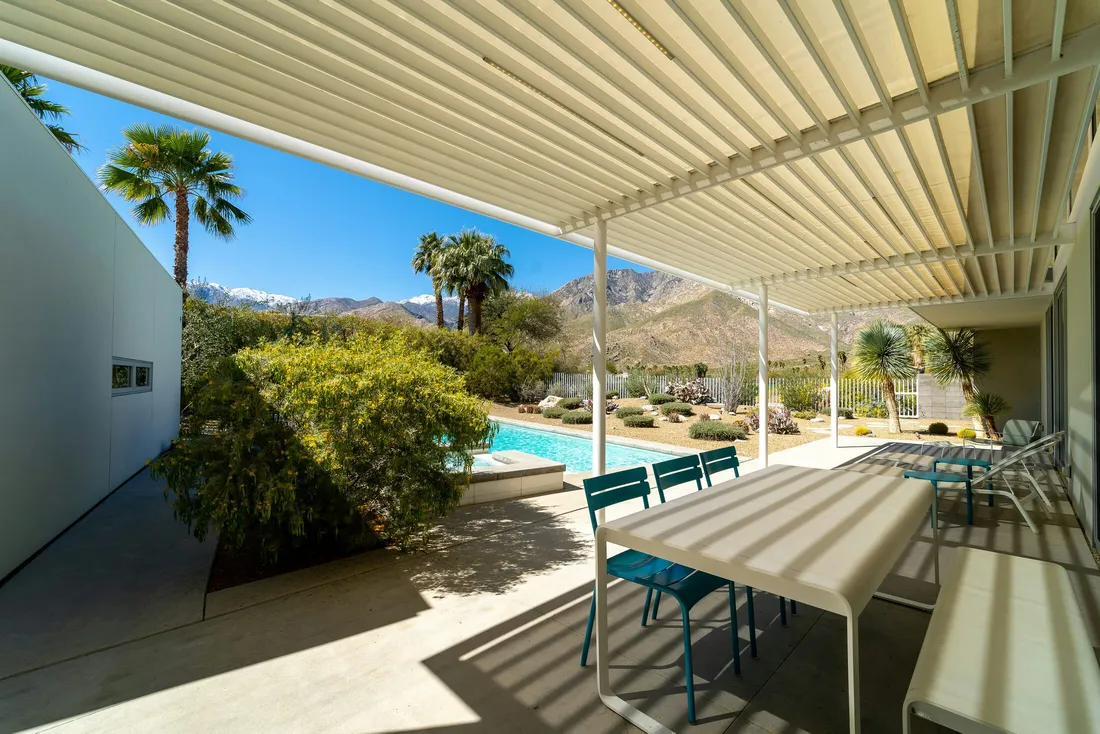
This is the most expensive way to cover a patio in Las Vegas, and the sales pitch for it is genuinely appealing: slats that tilt to track the sun, close against rain, and open flat when you want the sky back. Some of that pitch survives contact with the paperwork. Some of it does not.
We went looking for the evaluation reports, the wind ratings and the actual warranty schedules rather than the marketing pages. What follows is what those documents say.
What it costs
| Type | Per sq ft | 12 × 20 (240 sq ft) | What it is |
|---|---|---|---|
| Retractable fabric awning | $15–$30 | $1,000–$3,500 typical total | Fabric on folding arms. Retracts. Not a structure. |
| Aluminium solid, non-insulated | $22–$38 | $5,300–$9,100 | Fixed roof. The baseline for comparison. |
| Insulated aluminium panel | $32–$55 | $7,700–$13,200 | Fixed roof with a foam core. The usual valley upsell. |
| Louvered / motorised | $55–$130 | $13,200–$31,200 | Pivoting slats, opened and closed on demand. |
HomeGuide (2026-02-10): manual louvered $45–$110/sq ft, motorized $55–$125. Angi (2026-07-08): motorized $60–$130. Premium brands quote far higher and are listed separately.
Two add-ons come up constantly in this category and are worth pricing separately rather than accepting inside a bundled number:
| Item | Range | Source |
|---|---|---|
| Rain and wind sensors | $125–$200 each | HomeGuide louvered pergola guide (2026-02-10) $125–$175; Angi motorized pergola guide (2026-07-08) $125–$200 |
| Outdoor outlet | $150–$260 | Angi motorized pergola cost guide, updated 2026-07-08 |
| Motorised drop screens | $3,500–$9,500 | Valley Patios pricing guide, 2025-06-19 — a Southern California dealer, not a Las Vegas one; treat as an out-of-market reference point |
One national guide caps motorised louvered systems at $125 per square foot and then, on the same page and the same date, prices the best-known brand at $150 to $200 per square foot — above its own stated ceiling. We are not resolving that, because the contradiction is informative: brand-level pricing in this category sits above the category range, and published ranges do not reliably contain the flagship products. Treat any louvered range, including ours, as excluding the premium brands.
These are two different products, sold as one
"Retractable patio cover" gets used for both a motorised louvered aluminium roof and a fabric awning on folding arms. They are not comparable, and the difference is roughly five times per square foot.
A louvered pergola is a permanent structure. It is permitted as a building, it has footings, it stays up in weather, and the moving part is the slats. A retractable awning is a fabric canopy that extends over your patio and pulls back into a housing. It is not designed to resist wind — it is designed to get out of the way of it.
That distinction has a hard number attached. Published wind ratings for retractable fabric awnings cluster tightly at 20–25 mph, and the European product standard that classifies them tops out, for the folding-arm awnings sold residentially, at roughly 30 mph:
| Class | Beaufort | Wind speed | Approx. |
|---|---|---|---|
| Class 1 | Force 4 | 20–28 km/h | 12–17 mph |
| Class 2 | Force 5 | 29–38 km/h | 18–24 mph |
| Class 3 | Force 6 | 39–48 km/h | 24–30 mph |
The Las Vegas valley design criterion is a 98 mph ultimate design wind speed at Exposure C. A Class 3 awning is rated to roughly thirty. That is not a defect — an awning is supposed to be retracted before it gets windy, and a wind sensor exists to do that automatically. It is a reason not to think of one as a substitute for a patio cover.
The approval problem nobody mentions
This is the most decision-relevant thing on this page, and it is checkable from two public documents.
Aluminium patio cover systems get approved in this valley through evaluation reports — the ICC Evaluation Service or IAPMO reports that appear as checkboxes on the permit applications. A plan reviewer accepts the report instead of site-specific engineering. Every report carries a list of conditions of use, and those conditions are where the actual limits live.
The ICC Evaluation Service report covering the best-known motorised louvered pergola system states, in its conditions of use, that units in Seismic Design Category C, D, E or F are excluded.
The Southern Nevada Amendments to the 2024 International Residential Code, Table R301.2, place this valley in Seismic Design Category D.
Those two documents are directly incompatible. The report cannot be the basis of approval for that product here.
Two honest caveats on that. First, the exclusion is quoted verbatim from the report and the seismic category is quoted verbatim from the adopted amendments — both halves are primary sources. What a Clark County or Henderson plan reviewer does about it is our inference, not a quoted statement: the sensible reading is that the product needs site-specific engineering rather than the evaluation-report shortcut, which is a real cost and a real delay. Second, that report is written against the 2021 building code; no residential code edition is listed on it at all.
Now compare that with what the cheaper products carry:
| Product class | Codes the report covers | Seismic exclusion? |
|---|---|---|
| Flagship motorised louvered system | 2021 IBC only — no residential code edition listed | Yes — Seismic Design Category C, D, E and F excluded |
| Aluminium and steel patio covers (Amerimax / Alumawood) | 2024, 2021, 2018 and 2015 IBC and IRC | None stated |
| Aluminium and steel covers with foam-core panels (Four Seasons) | 2024, 2021, 2018 and 2015 IBC and IRC | None stated |
The two reports on the bottom rows are the ones printed as checkboxes on Henderson's and the City of Las Vegas's patio cover applications. They are current, they cover the residential code this valley actually enforces, and they carry no seismic exclusion. The premium product is the one with the thinner paperwork here.
We could not find an evaluation report for any motorised louvered system that covers Seismic Design Category D. That does not prove none exists. It does mean you should ask.
Wind ratings, and what "150 mph" is actually describing
The advertised numbers in this category are large: one brand claims 150 mph, another up to 190 mph. We tried to verify both against the certifications they cite and could not.
- The 150 mph claim is attributed to an ICC-ES report. Two separate reads of that report surfaced the conditions of use but produced no wind speed, no exposure category and no ultimate design wind speed — those live in design schedules spanning some thirty-five pages that did not extract.
- The 190 mph claim is attributed to a Miami-Dade Notice of Acceptance. The notice is genuine — we read its cover sheet, its test standard and its expiry date — but the design pressures live in referenced drawing sheets that are not part of the readable document. No wind speed appears anywhere in it.
Both brands state that their systems handle high wind by opening the louvers — one describes sensors that automatically open the louvers under high wind to protect the system, the other that louvers can be opened during extreme wind events to reduce pressure.
A motorised louvered roof survives serious wind by temporarily ceasing to be a roof. That is sensible engineering. It is not what a buyer hearing "rated to 150 mph" pictures.
The most transparent manufacturer data we found is European, and it is worth reading precisely because it publishes the caveats. One system's technical datasheet guarantees the roof to 160 km/h — about 99 mph — with the blades closed; a sibling model in the same range is guaranteed to 120 km/h, about 75 mph. Both cap the maximum wind speed for operating the roof at 50 km/h, roughly 31 mph, and both warn against opening the blades above that because they may begin to vibrate.
Do not read those European figures as code-equivalent. A European "wind guarantee" in km/h is a commercial warranty term; a United States ultimate design wind speed is a code design value with a specified gust duration, height and exposure category behind it. They are not the same quantity, and converting between them is approximate at best. What the European datasheets are good for is honesty about the operating limit — which is the number that will actually affect you.
What the warranty covers, tier by tier
"Limited lifetime warranty, transferable" is the headline. The component schedule underneath it is a different document, and this is where you can see what the manufacturers themselves expect to fail.
| Brand | Structure | Finish / mechanical | Motor |
|---|---|---|---|
| StruXure (Pergola X) Motor tier appears in the product brochure, not in the 'limited lifetime warranty' headline used on the website. | Limited lifetime | Manual operator 10 years | 5 years |
| Renson (Camargue / Algarve) Labour, travel and equipment hire expressly excluded. Structure drops to 5 years in coastal or heavy-pollution zones. | 10 years from registration | Paint, colour and shine 5 years | 2 years |
| Somfy (the motor supplier behind both) Installation and reinstallation costs expressly excluded. No heat or temperature exclusion published. | n/a — motors and controls only | n/a | 5 years, parts only |
The structure is warranted for decades or for life. The motor gets two to five years. Labour is excluded by all three — the motor supplier's warranty states plainly that all costs related to installation and reinstallation are not its responsibility, and the European manufacturer excludes travel expenses, hourly wages, and the cost of hiring an aerial platform or scaffolding to reach the failed part.
That is a coherent, honest position from the manufacturers. It is also a clear signal: they price the risk of a motor failing far higher than the risk of a beam failing, and they have declined to carry the labour cost of replacing one. On a roof-height installation, reaching the motor is a real part of the bill.
What nobody publishes: a heat limit. We checked five manufacturers' warranty documents and product datasheets for a temperature-related exclusion or a published operating temperature range for the motor. There is none. No heat exclusion, no UV exclusion, no maximum ambient temperature, in a valley that averages 78 days a year above 100 °F. The closest thing to a thermal limit anywhere in the documents is one manufacturer's note that the maximum continuous running time is about two minutes.
Running it and maintaining it
The electrical side is undemanding. The motor most commonly used in these systems draws 45 watts while running and nothing on standby, at 24 volts DC through a transformer. The detailed European datasheet specifies a 100 watt transformer, a 3 amp nominal motor current and a dedicated 16 amp breaker — although that is a 230 volt, 50 hertz specification, so treat the breaker and transformer as the transferable facts and not the supply voltage. No United States manufacturer we checked publishes a dedicated-circuit requirement at all.
Maintenance is a real running cost and it is worth putting a number on before you buy, not after. Published guidance is $2–$5 per sq ft, every one to three years. On a 400 square foot cover that is a meaningful sum per service visit, recurring. And that is the American figure — the European manufacturer recommends maintenance twice a year, which is two to six times more frequent. We are not going to reconcile those for you; they disagree, and a bidder telling you it is maintenance-free is contradicting both.
Is it worth it?
We looked hard for evidence either way and mostly found an absence, which is itself an answer.
- There is no resale data. The construction industry's main cost-versus-value research tracks 28 project categories and does not include patio covers, pergolas, louvered roofs or awnings at all. The nearest tracked project — a backyard patio — recouped 46 percent of its cost, against 89 to 95 percent for the much cheaper deck additions in the same report. That is suggestive about high-spend outdoor projects generally. It is not evidence about louvered covers, and we will not present it as such.
- There is no measured thermal comparison. We could not find a single study, instrumented test, or university or government source comparing a louvered roof against a solid or insulated cover for temperature. Every result was a vendor page. This mirrors what we found on the materials guide — no measured temperature difference between insulated and non-insulated covers exists either.
- There is no independent failure-rate data. No consumer agency figures, no warranty-claim statistics, no survey. The only critiques we found were published by companies selling the alternative. The manufacturers' own warranty schedules — lifetime structure, two-to-five-year motor, labour excluded — are the most reliable statement of where failure is expected that exists in public.
What we can say with sourcing: it costs two to four times an insulated panel roof, the flagship product's approval paperwork does not cover this seismic category, the wind numbers describe a louvers-open condition, the motor carries a fraction of the structure's warranty with labour excluded, and maintenance recurs. If the adjustability is what you want, those are the trade-offs — they are real, they are documented, and none of them is disqualifying on its own. Go in knowing them.
Five questions to ask a bidder
- What evaluation report is this system approved under, and what do its conditions of use say about seismic design category? If the answer is vague, ask for the report number and read it. They are public.
- Is the wind rating you quoted louvers-open or louvers-closed? And what is the maximum wind speed at which the roof may be operated?
- How long is the motor warranted, separately from the structure, and does the warranty include labour? Ask for the component schedule, not the brochure line.
- What does a motor replacement cost in year six, all in? Including access equipment.
- What is the maintenance interval and what does a service visit cost? Get it in writing before you sign.
Our contractor vetting guide covers the rest of the check, including Nevada's deposit cap and the licence details worth confirming before any money changes hands.
What we could not verify
- The 150 mph figure, against the report it is attributed to. The design schedules did not extract.
- The 190 mph figure, against the Miami-Dade notice it is attributed to. The design pressures are in referenced drawings.
- Whether either advertised figure describes louvers open or louvers closed.
- Whether any motorised louvered system anywhere holds an evaluation report covering Seismic Design Category D.
- Any published operating temperature range or heat-related warranty exclusion for the motors used in these systems.
- The nominal pressures behind the EN 13561 wind classes — the standard is paywalled, so only the speed and Beaufort equivalents are public.
- One flagship brand's actual warranty document: its warranty pages are JavaScript-gated and the 20-year figure that circulates comes from a dealer's summary rather than the manufacturer.
Common questions
How much does a motorized patio cover cost in Las Vegas?
What is the difference between a motorized louvered pergola and a retractable awning?
Are motorized louvered pergolas approved for Las Vegas?
How much wind can a motorized louvered patio cover take?
How long is the motor warranted on a louvered pergola?
Do motorized patio covers need a dedicated electrical circuit?
Sources
- ICC Evaluation Service — evaluation reports for patio cover systems (ESR-5321P, ESR-1398P, ESR-1953P) — Source for the codes each report covers and for the seismic design category exclusion quoted on this page. Read 2026-08-03.
- Clark County — Southern Nevada Amendments to the 2024 International Residential Code — Table R301.2: 98 mph ultimate design wind speed, Exposure C, Seismic Design Category D. Adopted 15 July 2025, effective 11 January 2026.
- Miami-Dade County — product control notices of acceptance — Source for the louvered pergola notice of acceptance, its test standard and its expiry. The design pressures are in referenced drawings not published in the notice.
- HomeGuide — louvered pergola cost guide — Updated 2026-02-10. Manual and motorised per-square-foot ranges, brand-level pricing, sensor and accessory costs.
- Angi — motorized pergola cost guide — Updated 2026-07-08. Source for the maintenance interval and per-square-foot maintenance cost, and the outdoor outlet figure.
- Angi — retractable awning cost guide — Source for the $15–$30 per square foot awning figure and the $2,700 average.
- HomeGuide — retractable awning cost guide — Updated 2023-04-11 — the oldest source used on this page, and flagged as such. Manual and motorised installed ranges, and the 20 to 25 mph wind guidance.
- EN 13561 wind classes for external blinds and awnings — The standard itself is paywalled. Class and Beaufort equivalents on this page come from two independent published summaries that agree to within about 1 km/h.
- Journal of Light Construction — Cost vs. Value Report, 2025 — Checked for resale data. All 28 tracked categories enumerated; no patio cover, pergola, louvered roof or awning category exists.
Las Vegas Patio Cover Guide is an independent research and referral service. We are not a licensed contractor, we do not perform construction work, and we do not sell patio covers. When you send a request through this site we pass it to an independent local contractor who is licensed to do the work. Any quote, contract, warranty and workmanship is between you and that contractor. Always verify a contractor's licence, status and monetary limit yourself at nvcontractorsboard.com before signing anything or paying a deposit.
Get bids on a motorised or fixed cover
Tell us what you are considering and we will pass it to independent contractors in your jurisdiction. If you are pricing a louvered system, ask each of them the evaluation report question above — the answers will tell you a lot.