
Permits · myth check
Do you need a permit for a patio cover in Las Vegas?
Three exemptions get repeated constantly in this market — under 200 square feet, open lattice, and freestanding. We went and read the code. None of the three survive contact with it.
Updated 2 August 2026 · Sources verified 2026-08-02 · Independent research, not a contractor
Yes. As of August 2026, every jurisdiction in the Las Vegas valley requires a building permit for a permanent patio cover — attached or freestanding, solid or open lattice, at any size. Clark County states it plainly: building permits are required for all free standing and attached structures including carports, shade structures and patio covers.
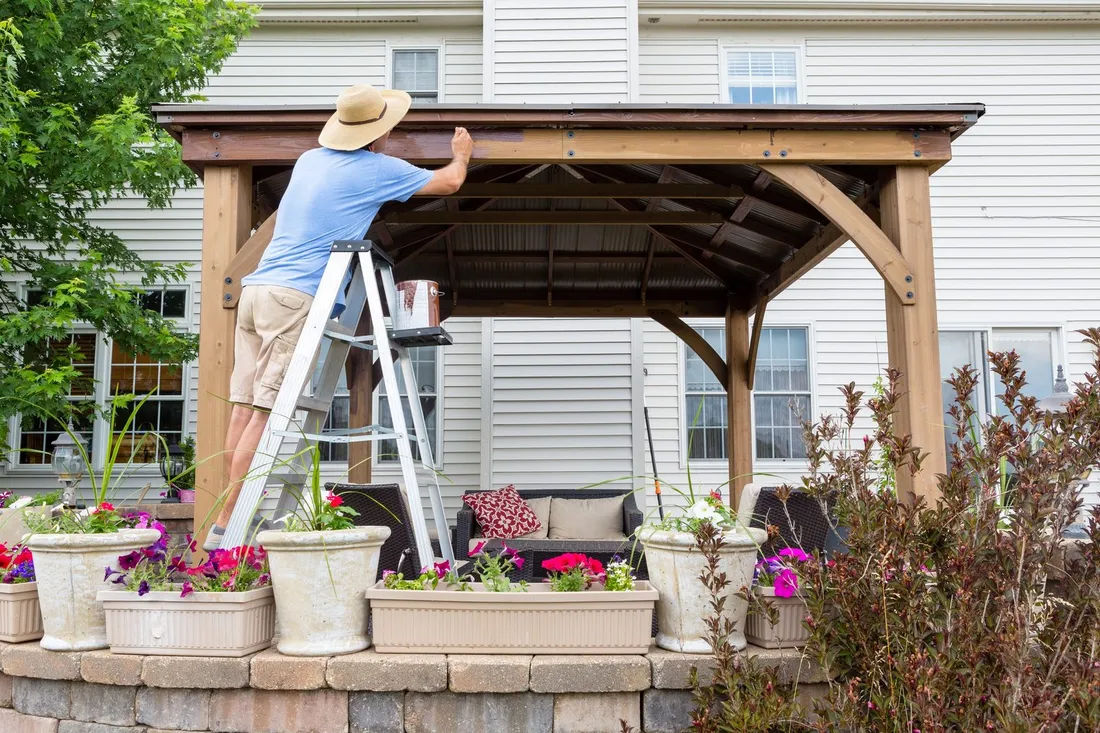
The short answer, and where it comes from
Clark County's code-enforcement guidance for single-family residential property says this, in one sentence, without qualification:
"Building permits are required for all free standing and attached structures including carports, shade structures and patio covers."
A pergola is a shade structure. A lattice cover is a shade structure. There is no size threshold in that sentence and no material qualification. That is the whole answer for unincorporated Clark County, and the other three valley jurisdictions land in the same place by slightly different routes.
What needs a permit, by structure type
| What you are building | Verdict | Why |
|---|---|---|
| Attached patio cover, any size | Permit required | Clark County requires permits for all attached and freestanding structures including patio covers. Henderson's only size exemption excludes anything attached to a building. |
| Freestanding patio cover, any size | Permit required | Clark County's code-enforcement guidance names free standing structures explicitly. Henderson exempts under-120 sq ft structures only if they are also not anchored to a permanent foundation. |
| Open-lattice cover or pergola on posts | Permit required | Neither pergola, lattice nor trellis appears anywhere in the Clark County exemption list. An open roof is still a roof structure carrying wind load. |
| Cover under 200 sq ft | Permit required | The 200 sq ft exemption is limited by use to tool sheds, storage sheds and playhouses — not patio covers. See below. |
| Carport | Permit required, and stricter | Clark County names carports explicitly. A carport is expressly excluded from the patio cover appendix, so it is engineered under the main body of the code. |
| Window awning projecting 54 inches or less | Exempt in Clark County | The one genuine awning exemption in the county code, and far too small to cover a patio. |
| Free-standing fabric shade or wood gazebo under 120 sq ft, Henderson | Exempt in Henderson only | Only if it is pre-manufactured, not attached to a building, and not anchored to a permanent foundation. All three conditions must hold. |
| Shade sail on existing posts or walls | Usually not a building permit — ask | Not a roofed structure, but attachment points and any new posts can change the answer. This one genuinely varies; call your jurisdiction. |
Myth 1: "Anything under 200 square feet is exempt"
This one is half-true in a way that makes it worse than a clean falsehood. Clark County does have a 200 square foot exemption. Here it is, verbatim, from section 22.02.190(A) of the county's Building Administrative Code:
"One-story detached accessory Buildings in conjunction with a single-family dwelling used as tool and storage sheds, playhouses and similar non-occupiable space, provided the floor area does not exceed 200 square feet; and no mechanical or plumbing is to be installed."
Read what limits it. The exemption is bounded by use — tool sheds, storage sheds, playhouses and similar non-occupiable space — and only then by size. A patio cover is not a tool shed. The county's own code enforcement page, quoted above, confirms the county does not read this section as reaching patio covers.
We also checked the rest of the list rather than stopping at the first hit. Section 22.02.190 runs from (A) through (W) and exempts things like oil derricks, water tanks under 5,000 gallons, walks and driveways not more than 30 inches above grade, interior finishes, storable pools, playground equipment, storage racks under 8 feet, portable spas, drywall repair under 30 square feet, and meteorological structures under 240 square feet. The words patio cover, pergola, lattice, trellis, gazebo and carport do not appear anywhere in it.
Where the myth comes from — and this part is genuinely interesting
The model International Building Code does carry a general 200 square foot exemption, at Section 105.2. National articles cite it constantly. It does not apply here, and the reason is unusually clean:
The Southern Nevada Amendments to the 2024 International Building Code delete Sections 103 through 116 in their entirety — which includes Section 105.2, the work-exempt-from-permit list — and direct you instead to "the Building Administrative Code (BAC), as adopted by each respective local Authority Having Jurisdiction."
So the model-code exemption everyone quotes has been affirmatively removed in this valley. What governs is each jurisdiction's own administrative code, and Clark County's limits its 200 square foot exemption to sheds and playhouses.
Henderson reaches the same destination with a different number. Henderson Municipal Code 15.01.130 exempts "pre-manufactured fabric sun shade and carport structures, wood gazebos and similar structures" under 120 square feet — but only where they are "not permanently affixed to an existing building nor anchored to a permanent foundation." Three conditions, all of which must hold. A patio cover bolted to your fascia fails the first. A freestanding one on footings fails the second.
Myth 2: "Open lattice doesn't count as a roof"
This is the most common version we hear in this market, and it is often stated with real confidence, sometimes by people selling lattice covers.
There is no lattice exemption. Neither lattice, pergola nor trellis appears in the Clark County exemption list at all, and Henderson treats lattice as a style option you declare on the patio cover application — right alongside solid, combination and insulated — not as a different class of structure. If lattice were exempt, it would not be a checkbox on the permit form.
Structurally the reason is obvious once stated. What the building department cares about is not whether the roof sheds rain. It is whether a structure with posts, beams and a footing connection stays standing in a 98 mph design wind event with people underneath it. An open lattice roof still catches wind, still transmits load into its posts, and still needs footings sized for the job. Clark County's adopted design criteria for this valley are a 98 mph ultimate design wind speed at Exposure Category C, Seismic Design Category D, and a one-foot frost line.
Myth 3: "It's freestanding, so it's not attached to the house"
Clark County's sentence names free standing structures first. Detaching the cover from the house changes what the engineer has to calculate — a freestanding cover carries all its own lateral load rather than bracing against the building — but it does not change whether you need a permit. If anything, freestanding covers get more scrutiny, not less, because they cannot borrow stiffness from the house.
Carports are a different animal, and stricter
Worth separating out, because people use "patio cover" and "carport" interchangeably and the code does not. Clark County adopts Appendix BF of the International Residential Code, which governs patio covers. That appendix defines a patio cover as a structure with open or glazed walls used for recreational outdoor living purposes — and then expressly excludes carports, garages, storage rooms and habitable rooms from what a patio cover may be used as.
The practical consequence: a structure you park a car under is not eligible for the lighter patio cover provisions and is engineered under the main body of the code instead. Henderson prices this difference into its fee schedule — a standard-plan carport permit starts at $893 for the first 600 square feet, against $326 for the first 200 square feet of patio roof cover. If you tell a contractor "patio cover" and mean "somewhere to park", say so early.
What actually happens if you skip it
Contractors tend to describe this vaguely, so here are the four real exposures, roughly in order of how often they bite:
- Code enforcement. The usual trigger is a neighbour complaint, not a patrol. The outcome is normally an after-the-fact permit application, which means opening up finished work for inspection, at penalty rates — or, if it cannot be made to comply, removal.
- Resale. Unpermitted square footage and structures show up as a gap between what the county has on record and what a buyer's inspector is standing under. It is a routine renegotiation lever and it arrives at the worst possible moment.
- Insurance. A claim connected to an unpermitted structure — wind damage, or worse, an injury underneath one — is exactly the fact pattern an adjuster looks for.
- Your consumer protection evaporates. This is the one almost nobody mentions. Nevada's Residential Recovery Fund reimburses homeowners up to $40,000 when a licensed contractor takes their money and fails to perform. It only pays out on work done by a licensed contractor under a proper contract. Nevada law also requires the contractor to apply for and obtain the necessary permits as part of that contract. A handshake job with no permit puts you outside the fund's reach before anything goes wrong. We walk through this in the contractor vetting guide.
How to check yours in five steps
- Work out which jurisdiction you are actually in. A Las Vegas mailing address does not mean the City of Las Vegas. Summerlin, Spring Valley, Enterprise, Paradise and the Strip are unincorporated Clark County. Henderson and North Las Vegas run their own departments. Look up your parcel on the county assessor's site if you are unsure.
- Assume the permit is required and look for a reason it is not. In every valley jurisdiction, a permanent patio cover requires a permit. Read your jurisdiction's exemption list yourself rather than relying on a contractor's summary of it.
- Ask the building department directly, and write down who told you. Clark County's permit line is 702-455-4431, Henderson 702-267-3620, City of Las Vegas 702-229-6251, North Las Vegas 702-633-1536. Note the date, the name and what you asked.
- Get your HOA's written approval separately. A building permit is a public safety and zoning approval. HOA approval is a private covenant approval under NRS 116.2111. Neither substitutes for the other, and the HOA is the one that can force removal.
- Make the permit the contractor's contractual obligation, in writing. Nevada law requires a residential contractor to apply for and obtain the necessary permits. Put the permit number in the contract and do not release final payment until the final inspection has passed.
Jurisdiction-by-jurisdiction fees, submittal requirements and contacts are in the permit guide, and the Henderson fee arithmetic is worked through on the Henderson cost page.
Common questions
Do I need a permit for a patio cover in Las Vegas?
Is a patio cover under 200 square feet exempt in Las Vegas?
Do pergolas and open-lattice patio covers need a permit in Las Vegas?
Doesn't the International Building Code exempt structures under 200 square feet?
What happens if I build a patio cover without a permit in Las Vegas?
Does a freestanding patio cover need a permit if it does not touch the house?
Once you have accepted that you need one
- The Henderson permit, step by step — the most completely documented of the four jurisdictions.
- How long the permit and the build actually take.
- Cover vs pergola vs sunroom — where the enclosure line falls, and why a screen and a pane of glass are not the same decision.
Sources
- Clark County Code Enforcement — Building Violations, Single Family Residential — source of the quoted sentence on free standing and attached structures
- Clark County Building Administrative Code, Title 22 Chapter 22.02, section 22.02.190 — permit exemptions — the verbatim 200 sq ft exemption and the full (A)–(W) list
- Southern Nevada Amendments to the 2024 International Building Code, Clark County amended — deletes IBC Sections 103 through 116, including 105.2
- Southern Nevada Amendments to the 2024 International Residential Code, Clark County amended — adopts Appendix BF Patio Covers; Table R301.2 design criteria including the 98 mph wind speed
- Henderson Municipal Code Title 15, section 15.01.130 — work exempt from a building permit — the 120 sq ft exemption and its three conditions
- City of Henderson — Patio Cover (Residential) submittal checklist — lattice listed as a style option on the application
- Nevada State Contractors Board — Residential Recovery Fund
Want a contractor who pulls the permit?
Tell us what you are planning and we will pass it to independent local contractors. Ask each of them for the permit number before you pay anything.
Las Vegas Patio Cover Guide is an independent research and referral service. We are not a licensed contractor, we do not perform construction work, and we do not sell patio covers. When you send a request through this site we pass it to an independent local contractor who is licensed to do the work. Any quote, contract, warranty and workmanship is between you and that contractor. Always verify a contractor's licence, status and monetary limit yourself at nvcontractorsboard.com before signing anything or paying a deposit.